Toxicity by consortium
A compound inherits from the compounds it resembles. Draw a molecule and the compounds in the public reference set that are similar enough to it vote on how toxic it is. When nothing is similar enough, the method declines, and that is the answer.
Accuracy and coverage are two numbers, always
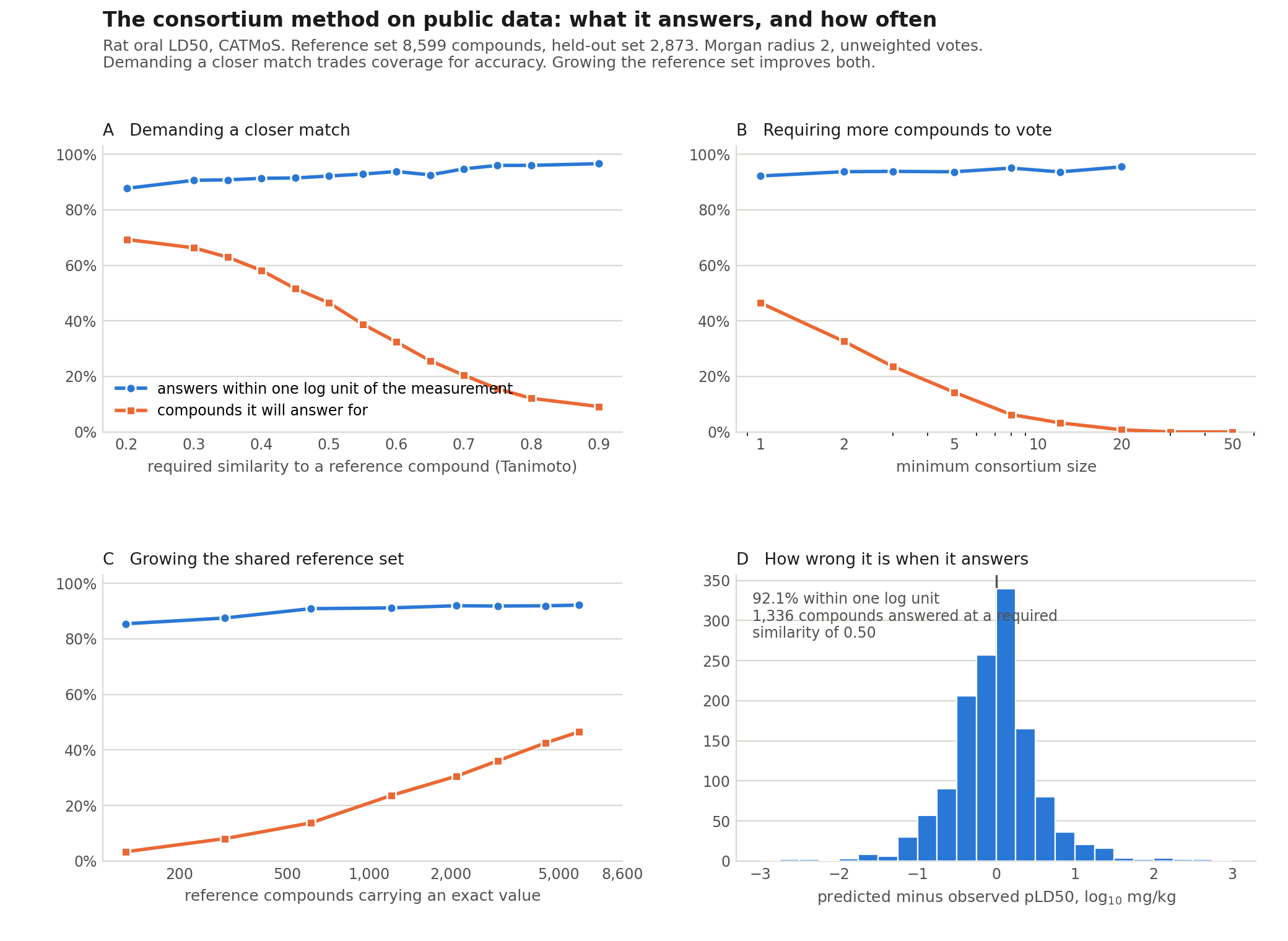
Raising the similarity a reference compound must reach before it may vote raises accuracy and lowers the share of compounds answered for. Across the sweep, accuracy runs 87.7% to 96.6% while coverage runs 69.3% down to 9.2%. No setting escapes that trade, and this site never shows one of the pair without the other.
A shared pool buys reach, not accuracy
Growing the voting reference set from 127 to 5,953 compounds carrying a measured LD50 leaves accuracy between 85.4% and 92.1% while the share of compounds answered for rises from 3.3% to 46.5%. That is the case for pooling: a larger consortium does not make a call better, it makes more calls possible. The sampled reference set is 8,599 compounds, of which 5,953 carry an exact LD50 and may vote.
The second signal: how widely a compound reaches
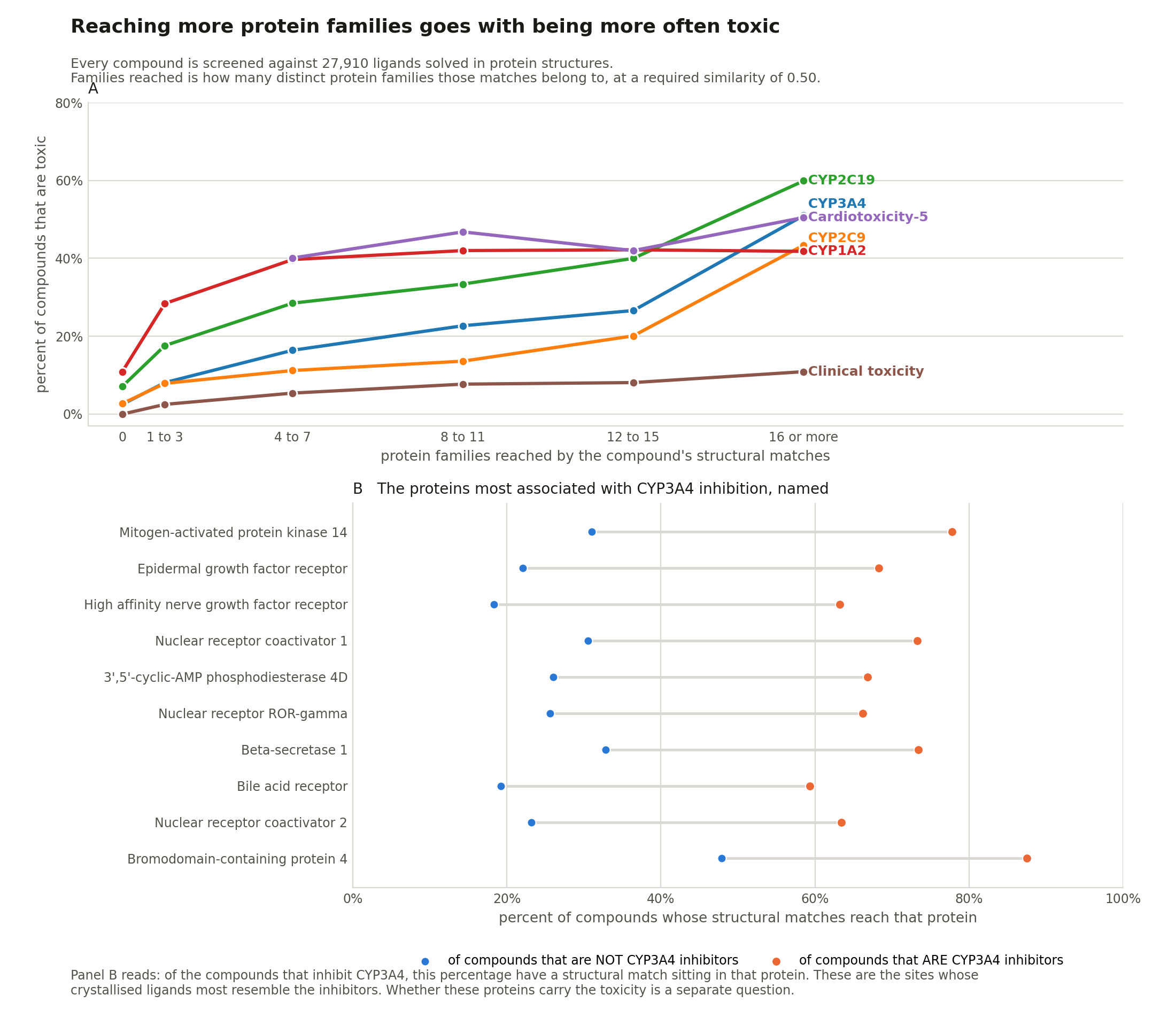
A compound whose structural matches reach no protein family inhibits CYP3A4 2.5% of the time. One reaching sixteen or more inhibits it 51.0%. The count comes from screening the query against the Reverse Screen index of ligands solved in protein structures, kept current with reversescreen.ai, and counting the distinct protein families their structures were solved against; it needs no protein structure and no docked pose.
Twelve compounds that reach widely
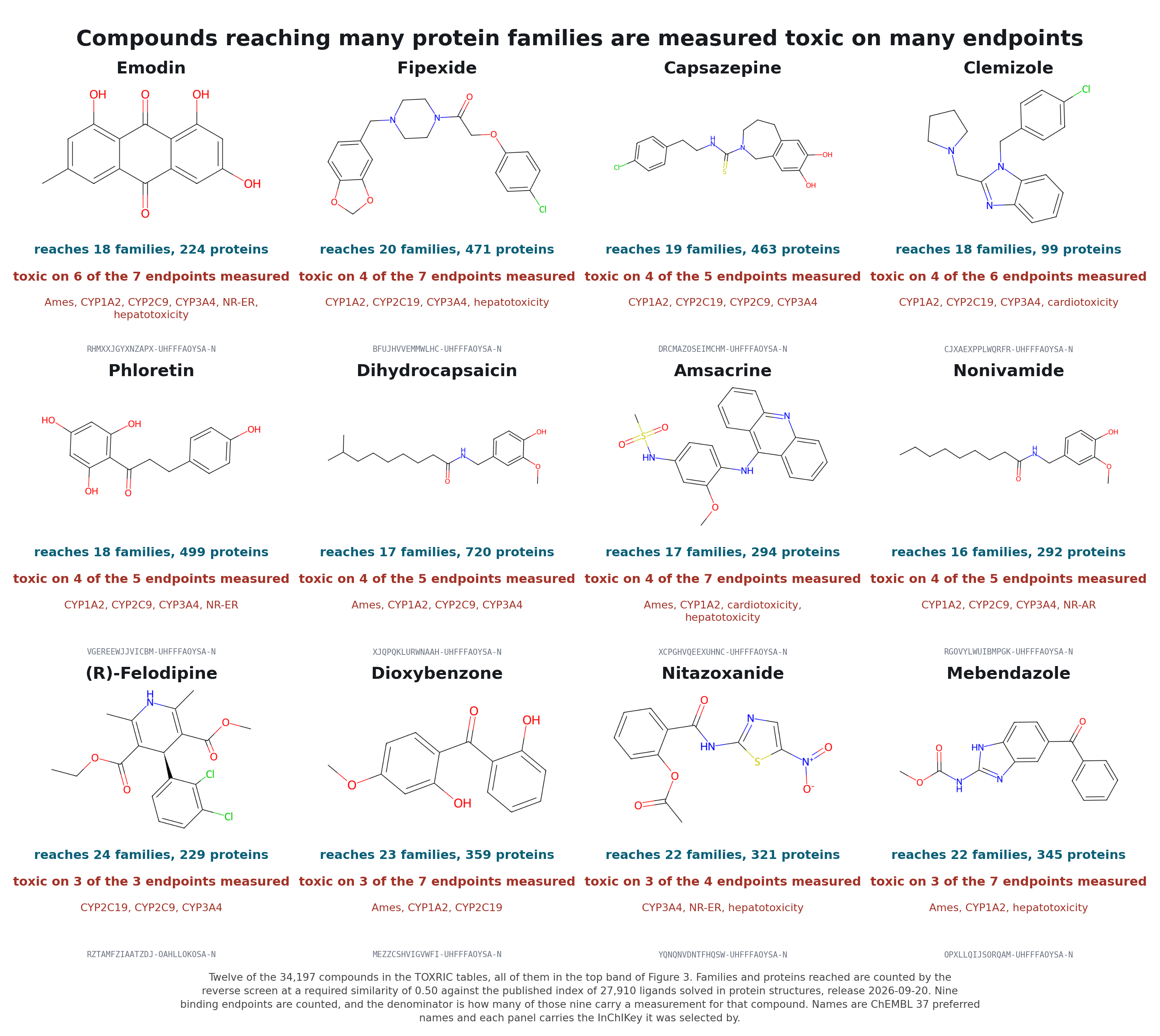
Every SMILES below is selectable, and clicking one loads it straight into the editor on the scoring page.
| Compound | Families | Proteins | Toxic on | SMILES |
|---|---|---|---|---|
| Emodin | 18 | 224 | 6 of 7 | Cc1cc(O)c2c(c1)C(=O)c1cc(O)cc(O)c1C2=O |
| Fipexide | 20 | 471 | 4 of 7 | O=C(COc1ccc(Cl)cc1)N1CCN(Cc2ccc3c(c2)OCO3)CC1 |
| Capsazepine | 19 | 463 | 4 of 5 | Oc1cc2c(cc1O)CN(C(=S)NCCc1ccc(Cl)cc1)CCC2 |
| Clemizole | 18 | 99 | 4 of 6 | Clc1ccc(Cn2c(CN3CCCC3)nc3ccccc32)cc1 |
| Phloretin | 18 | 499 | 4 of 5 | O=C(CCc1ccc(O)cc1)c1c(O)cc(O)cc1O |
| Dihydrocapsaicin | 17 | 720 | 4 of 5 | COc1cc(CNC(=O)CCCCCCC(C)C)ccc1O |
| Amsacrine | 17 | 294 | 4 of 7 | COc1cc(NS(C)(=O)=O)ccc1Nc1c2ccccc2nc2ccccc12 |
| Nonivamide | 16 | 292 | 4 of 5 | CCCCCCCCC(=O)NCc1ccc(O)c(OC)c1 |
| (R)-Felodipine | 24 | 229 | 3 of 3 | CCOC(=O)C1=C(C)NC(C)=C(C(=O)OC)[C@H]1c1cccc(Cl)c1Cl |
| Dioxybenzone | 23 | 359 | 3 of 7 | COc1ccc(C(=O)c2ccccc2O)c(O)c1 |
| Nitazoxanide | 22 | 321 | 3 of 4 | CC(=O)Oc1ccccc1C(=O)Nc1ncc([N+](=O)[O-])s1 |
| Mebendazole | 22 | 345 | 3 of 7 | COC(=O)Nc1nc2cc(C(=O)c3ccccc3)ccc2[nH]1 |
How reach is computed, and its exceptions.
What it is for
Scoring a library before any of it is made, then throwing away the worst of it. The method helps most where the problem is rare, which is where a program does not see it coming until a chemical series has already been spent on it. Every endpoint and its operating point is published, including the ones where the method is weak.