Cross-family reach
The second signal. How many distinct protein families a compound's chemistry reaches in the crystallographic record. It is not the consortium vote and it is not computed the same way.
The query is fingerprinted with PharmCast and screened against the Reverse Screen index, release 2026-09-20, 27,910 indexed ligands. The proteins those matched ligands were solved against are collected, and their distinct families are counted. No protein structure, no docked pose and no three dimensional model of the query is needed.
| Endpoint | Reaching no family | Reaching 16 or more | Compounds |
|---|---|---|---|
| Ames Mutagenicity | 52.3% | 47.9% | 6,875 |
| CYP1A2 | 10.9% | 41.8% | 9,212 |
| CYP2C19 | 7.1% | 59.9% | 10,095 |
| CYP2C9 | 2.7% | 43.4% | 9,405 |
| CYP2D6 | 5.9% | 13.6% | 10,201 |
| CYP3A4 | 2.5% | 51.0% | 10,887 |
| Carcinogenicity | 52.9% | 36.8% | 1,000 |
| Clinical toxicity | 0.0% | 10.9% | 1,242 |
| Eye Corrosion | 82.2% | 1.9% | 2,200 |
| Eye Irritation | 94.9% | 22.4% | 5,052 |
| Hepatotoxicity | 47.3% | 47.1% | 2,805 |
| NR-AR | 1.4% | 7.2% | 6,873 |
| NR-AR-LBD | 1.2% | 6.1% | 6,410 |
| NR-AhR | 7.5% | 13.9% | 6,200 |
| NR-ER | 7.2% | 14.2% | 5,875 |
| NR-ER-LBD | 2.2% | 4.9% | 6,589 |
| NR-PPAR-gamma | 1.3% | 5.1% | 6,106 |
| NR-aromatase | 2.0% | 11.4% | 5,515 |
| Respiratory Toxicity | 71.3% | 57.0% | 1,195 |
| SR-ARE | 10.3% | 23.3% | 5,535 |
| SR-ATAD5 | 2.3% | 4.1% | 6,706 |
| SR-HSE | 3.8% | 7.8% | 6,138 |
| SR-MMP | 7.2% | 25.5% | 5,511 |
| SR-p53 | 2.6% | 9.5% | 6,417 |
Two endpoints run the other way
CYP2D6 rises to the middle bands and then falls back, and carcinogenicity runs backwards across the whole range. Both are in the table above and neither is hidden: a signal that holds on most endpoints and not on all is what the measurement found.
It is not a compound finding its own analogs
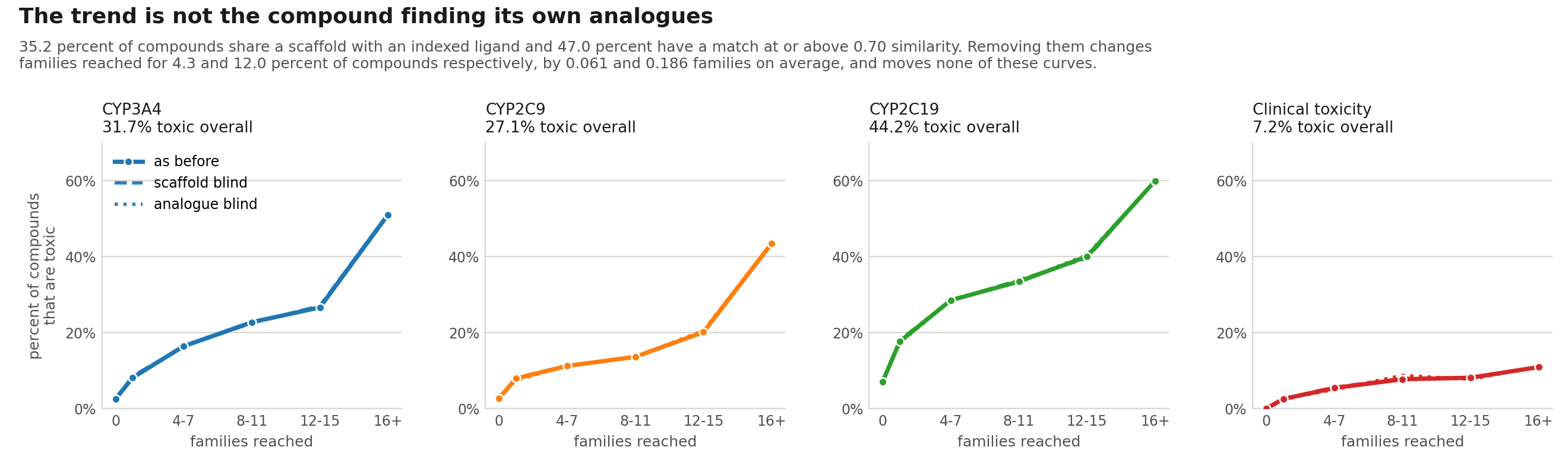
Removing every indexed ligand that shares a scaffold with the query, and then every close analog of it, leaves the bands where they were. No band moves by more than half a percentage point.
The same index answers reversescreen.ai, where a molecule can be taken further and docked into the sites it reaches.