The 28 endpoints
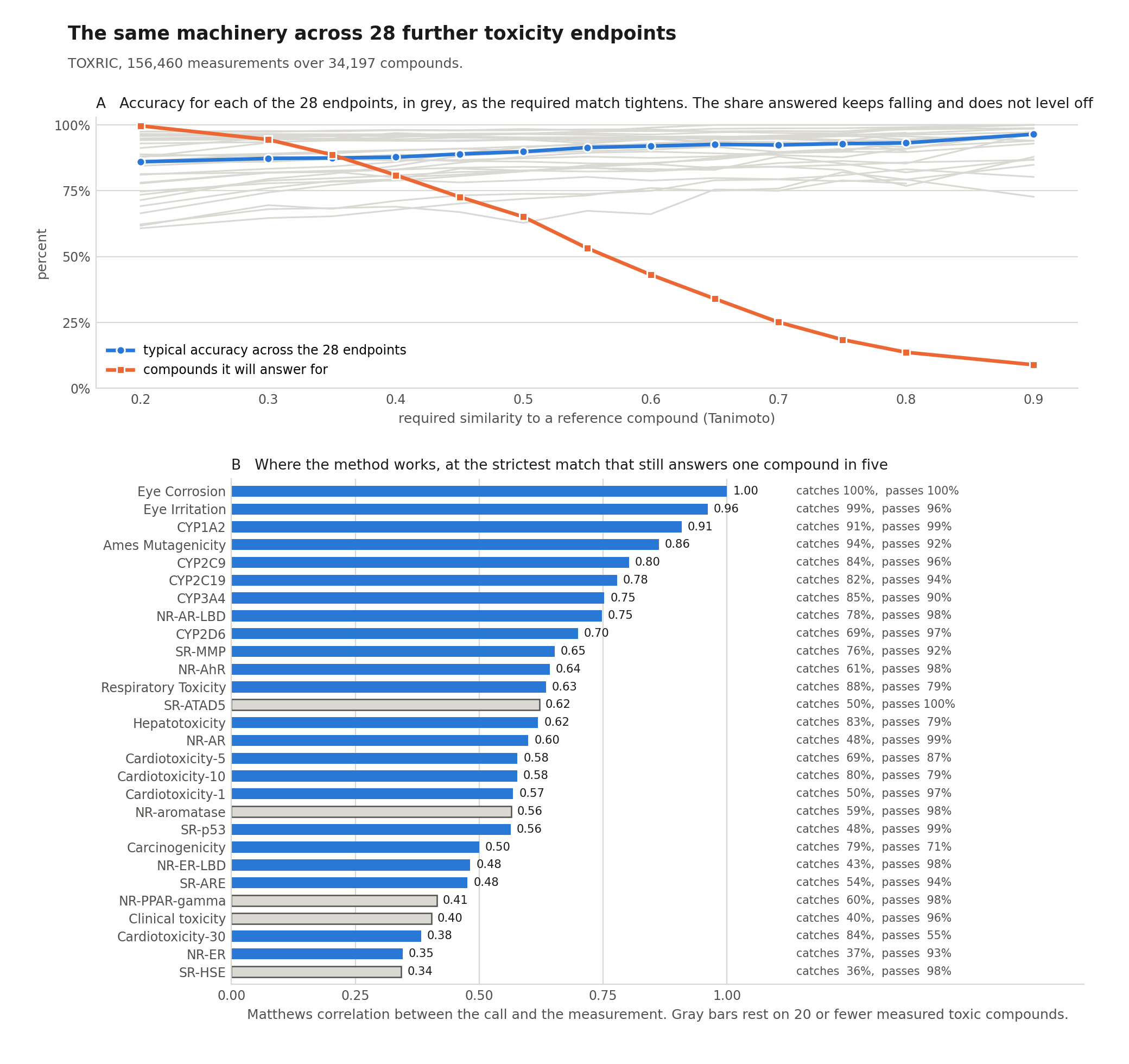
The same method, with only the required similarity set per endpoint. Each row is that endpoint at its operating point: the strictest match that still answers about one compound in five.
Two rates are reported rather than percent correct. The labels are lopsided on most of these endpoints, and that ratio records which compounds were tested and reported rather than anything about chemistry. Caught is the share of measured actives called active. Passed is the share of measured inactives called inactive.
| Category | Endpoint | Required similarity | Coverage | Caught | Passed | MCC | Measured actives |
|---|---|---|---|---|---|---|---|
| Irritation and Corrosion | Eye Corrosion | 0.65 | 23.4% | 100.0% | 100.0% | 1.00 | 62 |
| Irritation and Corrosion | Eye Irritation | 0.65 | 26.8% | 99.2% | 96.5% | 0.96 | 260 |
| CYP450 | CYP1A2 | 0.75 | 21.9% | 90.7% | 98.6% | 0.91 | 161 |
| Mutagenicity | Ames Mutagenicity | 0.80 | 21.1% | 94.3% | 91.8% | 0.86 | 212 |
| CYP450 | CYP2C9 | 0.75 | 21.6% | 84.0% | 95.7% | 0.80 | 119 |
| CYP450 | CYP2C19 | 0.75 | 22.5% | 82.1% | 94.2% | 0.78 | 207 |
| CYP450 | CYP3A4 | 0.75 | 20.5% | 85.4% | 89.7% | 0.75 | 260 |
| Endocrine Disruption | NR-AR-LBD | 0.70 | 26.0% | 77.8% | 98.2% | 0.75 | 27 |
| CYP450 | CYP2D6 | 0.75 | 21.2% | 68.8% | 97.0% | 0.70 | 80 |
| Endocrine Disruption | SR-MMP | 0.70 | 23.8% | 76.4% | 92.4% | 0.65 | 55 |
| Endocrine Disruption | NR-AhR | 0.70 | 23.9% | 60.6% | 98.0% | 0.64 | 33 |
| Respiratory Toxicity | Respiratory Toxicity | 0.75 | 26.6% | 87.5% | 79.0% | 0.63 | 56 |
| Endocrine Disruption | SR-ATAD5 | 0.70 | 25.1% | 50.0% | 99.5% | 0.62 | 16 |
| Hepatotoxicity | Hepatotoxicity | 0.75 | 22.8% | 83.1% | 78.8% | 0.62 | 77 |
| Endocrine Disruption | NR-AR | 0.70 | 23.5% | 48.5% | 99.0% | 0.60 | 33 |
| Cardiotoxicity | Cardiotoxicity-5 | 0.80 | 26.5% | 69.4% | 87.0% | 0.58 | 36 |
| Cardiotoxicity | Cardiotoxicity-10 | 0.80 | 26.5% | 79.6% | 78.8% | 0.58 | 49 |
| Cardiotoxicity | Cardiotoxicity-1 | 0.80 | 26.5% | 50.0% | 96.8% | 0.57 | 20 |
| Endocrine Disruption | NR-aromatase | 0.70 | 22.1% | 58.8% | 97.6% | 0.56 | 17 |
| Endocrine Disruption | SR-p53 | 0.70 | 22.8% | 47.6% | 98.9% | 0.56 | 21 |
| Carcinogenicity | Carcinogenicity | 0.65 | 21.2% | 78.6% | 71.4% | 0.50 | 28 |
| Endocrine Disruption | NR-ER-LBD | 0.70 | 25.0% | 43.5% | 98.2% | 0.48 | 23 |
| Endocrine Disruption | SR-ARE | 0.70 | 22.5% | 54.3% | 93.9% | 0.48 | 35 |
| Endocrine Disruption | NR-PPAR-gamma | 0.70 | 25.2% | 60.0% | 98.2% | 0.41 | 5 |
| Clinical Toxicity | Clinical toxicity | 0.70 | 20.8% | 40.0% | 96.4% | 0.40 | 5 |
| Cardiotoxicity | Cardiotoxicity-30 | 0.80 | 26.5% | 83.9% | 55.0% | 0.38 | 62 |
| Endocrine Disruption | NR-ER | 0.70 | 23.8% | 36.8% | 93.2% | 0.35 | 57 |
| Endocrine Disruption | SR-HSE | 0.70 | 22.0% | 36.4% | 97.9% | 0.34 | 11 |
Five endpoints rest on fewer than twenty measured actives; the measured active column is there so a reader can see which. Cardiotoxicity at 30 micromolar is the one endpoint that fails in the other direction, catching most of the actives and passing few of the inactives.
Eye corrosion is the one endpoint that answers perfectly, 100.0% caught and 100.0% passed at a required similarity of 0.65. It does so for 23.4% of compounds and rests on 62 measured actives, and its positive class is small reactive molecules, which are the easiest kind to match to a close neighbor. The fingerprint is folded to 1,024 bits, so distinct structures can share one. Read the score with the coverage and the count beside it.
The reference sets behind them
| Category | Endpoint | Records | Unique compounds |
|---|---|---|---|
| CYP450 | CYP1A2 | 9,690 | 9,212 |
| CYP450 | CYP2C19 | 10,530 | 10,095 |
| CYP450 | CYP2C9 | 9,841 | 9,405 |
| CYP450 | CYP2D6 | 10,618 | 10,201 |
| CYP450 | CYP3A4 | 11,288 | 10,887 |
| Carcinogenicity | Carcinogenicity | 1,021 | 1,000 |
| Cardiotoxicity | Cardiotoxicity-1 | 1,547 | 1,295 |
| Cardiotoxicity | Cardiotoxicity-10 | 1,547 | 1,295 |
| Cardiotoxicity | Cardiotoxicity-30 | 1,547 | 1,295 |
| Cardiotoxicity | Cardiotoxicity-5 | 1,547 | 1,295 |
| Clinical Toxicity | Clinical toxicity | 1,430 | 1,242 |
| Developmental and Reproductive Toxicity | Developmental Toxicity | 218 | 187 |
| Developmental and Reproductive Toxicity | Reproductive Toxicity | 156 | 146 |
| Endocrine Disruption | NR-AR | 7,118 | 6,873 |
| Endocrine Disruption | NR-AR-LBD | 6,629 | 6,410 |
| Endocrine Disruption | NR-AhR | 6,410 | 6,200 |
| Endocrine Disruption | NR-ER | 6,068 | 5,875 |
| Endocrine Disruption | NR-ER-LBD | 6,820 | 6,589 |
| Endocrine Disruption | NR-PPAR-gamma | 6,322 | 6,106 |
| Endocrine Disruption | NR-aromatase | 5,707 | 5,515 |
| Endocrine Disruption | SR-ARE | 5,712 | 5,535 |
| Endocrine Disruption | SR-ATAD5 | 6,931 | 6,706 |
| Endocrine Disruption | SR-HSE | 6,338 | 6,138 |
| Endocrine Disruption | SR-MMP | 5,700 | 5,511 |
| Endocrine Disruption | SR-p53 | 6,636 | 6,417 |
| Hepatotoxicity | Hepatotoxicity | 2,889 | 2,805 |
| Irritation and Corrosion | Eye Corrosion | 2,242 | 2,200 |
| Irritation and Corrosion | Eye Irritation | 5,125 | 5,052 |
| Mutagenicity | Ames Mutagenicity | 7,485 | 6,875 |
| Respiratory Toxicity | Respiratory Toxicity | 1,348 | 1,195 |
Across the 28 scored endpoints the table holds 149,224 measurements over 34,162 compounds, from 156,086 raw records before duplicate resolution. A measurement is one value for one compound on one endpoint. The compound total is lower than the sum of the unique compound column because a compound measured on several endpoints appears in several rows. The table lists 30 endpoints. Developmental Toxicity and Reproductive Toxicity are not scored and are not in these totals.
Where these data come from
Every endpoint on this page is public, and every measurement behind it was published by someone else. The links go to the source rather than to our copy of it.
| Source | What it provides | Where |
|---|---|---|
| TOXRIC | The 28 scored endpoints, from a curated collection of toxicity measurements spanning acute toxicity, the cytochromes, mutagenicity, carcinogenicity, cardiotoxicity, hepatotoxicity, irritation and the Tox21 nuclear receptor and stress response panels. | toxric.bioinforai.tech |
| CATMoS, through the OPERA release | The rat oral LD50 measurements behind the acute traffic light, experimental values only. | NIEHS OPERA |
| Tox21 | The original assay program behind the NR and SR endpoints in the table above. | tripod.nih.gov/tox21 |
| OpenADMET, CYP challenge | The CYP3A4 inhibition measurements on outside compounds behind the external reach result, from a public consortium release. | openadmet.org |
| The Reverse Screen index | The 33,642 indexed ligands behind the cross-family reach signal. | reversescreen.ai |
The toxpred package fetches both reference sets for you with toxpred fetch, and toxpred provenance prints the URL, the size and the sha256 of every file it took. The download page carries the same checksums for the files this site scores against.
Two of these thirty carry too few compounds to score against and are not offered: developmental toxicity and reproductive toxicity. The 28 that are scored are the ones above that floor.
Running a library through the score
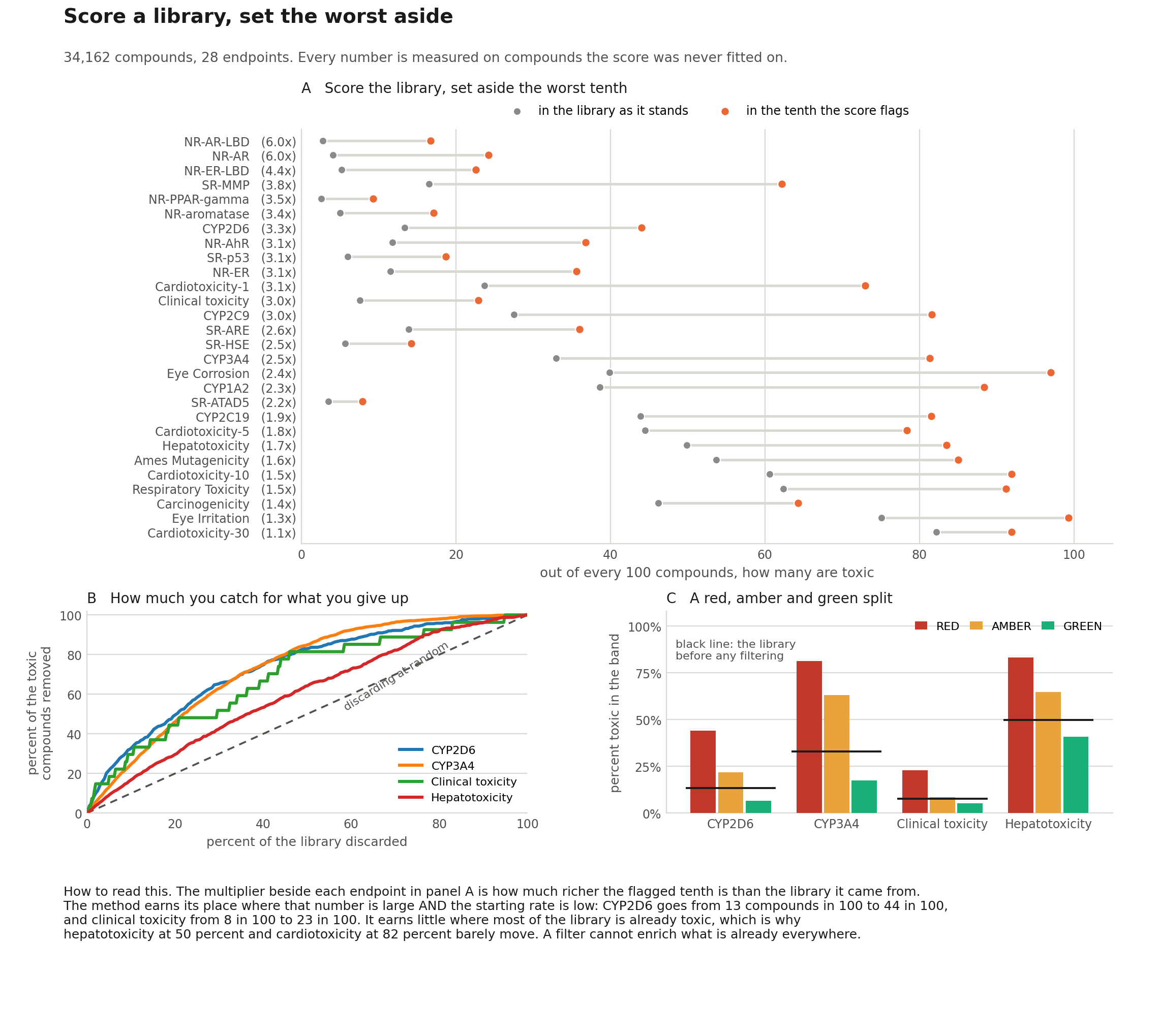
The retrieval measures, the cross-family target preferences and the size descriptors combine into one score, fitted on 70% of the compounds and measured only on the 30% held back. The consortium predictions are evaluated separately and are not inputs to it. Put a library through it and the question is what the worst scoring tenth contains.
| Endpoint | In the library | In the flagged tenth | Fold | Share of all its actives |
|---|---|---|---|---|
| NR-AR-LBD | 2.8 in 100 | 16.7 in 100 | 6.0 | 60.4% |
| NR-AR | 4.1 in 100 | 24.2 in 100 | 6.0 | 59.5% |
| CYP2D6 | 13.4 in 100 | 44.0 in 100 | 3.3 | 32.8% |
| Clinical toxicity | 7.6 in 100 | 22.9 in 100 | 3.0 | 29.6% |
| CYP3A4 | 33.0 in 100 | 81.3 in 100 | 2.5 | 24.7% |
Read a row as a pair. The tenth the score flags holds 16.7 actives in 100 at the androgen receptor ligand binding domain where the library it came from held 2.8, and that tenth carries 60.4% of every active in the set.
Discarding the worst scoring fifth rather than the tenth removes 64.1% of the androgen receptor ligand binding domain actives, 67.9% of the androgen receptor actives, 49.6% of the CYP2D6 inhibitors and 46.4% of the CYP3A4 inhibitors, against 20% for discarding at random.
What the score can buy is set by how rare the outcome is. Where half the library already carries the endpoint there is little to sort: hepatotoxicity moves from 49.9 in 100 to 83.5, and cardiotoxicity at 30 micromolar from 82.2 to 91.9. The method earns its place on the rare outcomes, which are also the ones a triage step is run to find.